The Spatial Relationship between Gentrification and Veganism in Minneapolis
Ashley Cofrin. Spring, 2021

In the following visualizations, I use Minneapolis data from 2000, 2010, and 2018 to investigate trends between gentrified areas and the emergence of veganism in the city.
Gentrification
Although gentrification has been studied extensively from multiple disciplinary perspectives (Goetz, 2019), it is a phenomena that does not have a single definition or outcome. It is commonly connoted as a negative process; however, even low-income households that worry about gentrification are frequently in favor of neighborhood improvement, but show active concern of displacement (Goetz, 2019). Because of the lack of a universal definition, researchers use a number of different measures of gentrification. I use three factors to gauge gentrification: income, percent of people with some college education, and percent of owner versus renter occupied spaces per block area in Minneapolis. I calculated principal component analysis scores of these three factors and added them to create one index score. On the map, this index score is referred to as “score of advantages” due to recent discussions considering that gentrification itself is hard to score and has many changing factors. Calculating gentrification in this way will show the spatial pattern of shifting advantages in Minneapolis; making it possible to show its potential correlation to vegan restaurants in the area.
Veganism
In recent years, vegan diets have been continuously portrayed as elitist and expensive; while also growing in popularity in primarily white privileged areas (Corsetti, 2018). Vegan food often comes at a higher price than other foods and is marketed towards a more middle class crowd, who have more advantages. With the previously calculated 'score of advantages', we can see if veganism rises in conjunction with gentrified areas. For this analysis, I defined vegan restaurants as ones that showed up in the app “Happy Cow''. I choose to do this due to its high accessibility for people looking for vegan restaurants along with its popularity as the most used app among people who eat vegan, suggesting its accuracy according to the user community.
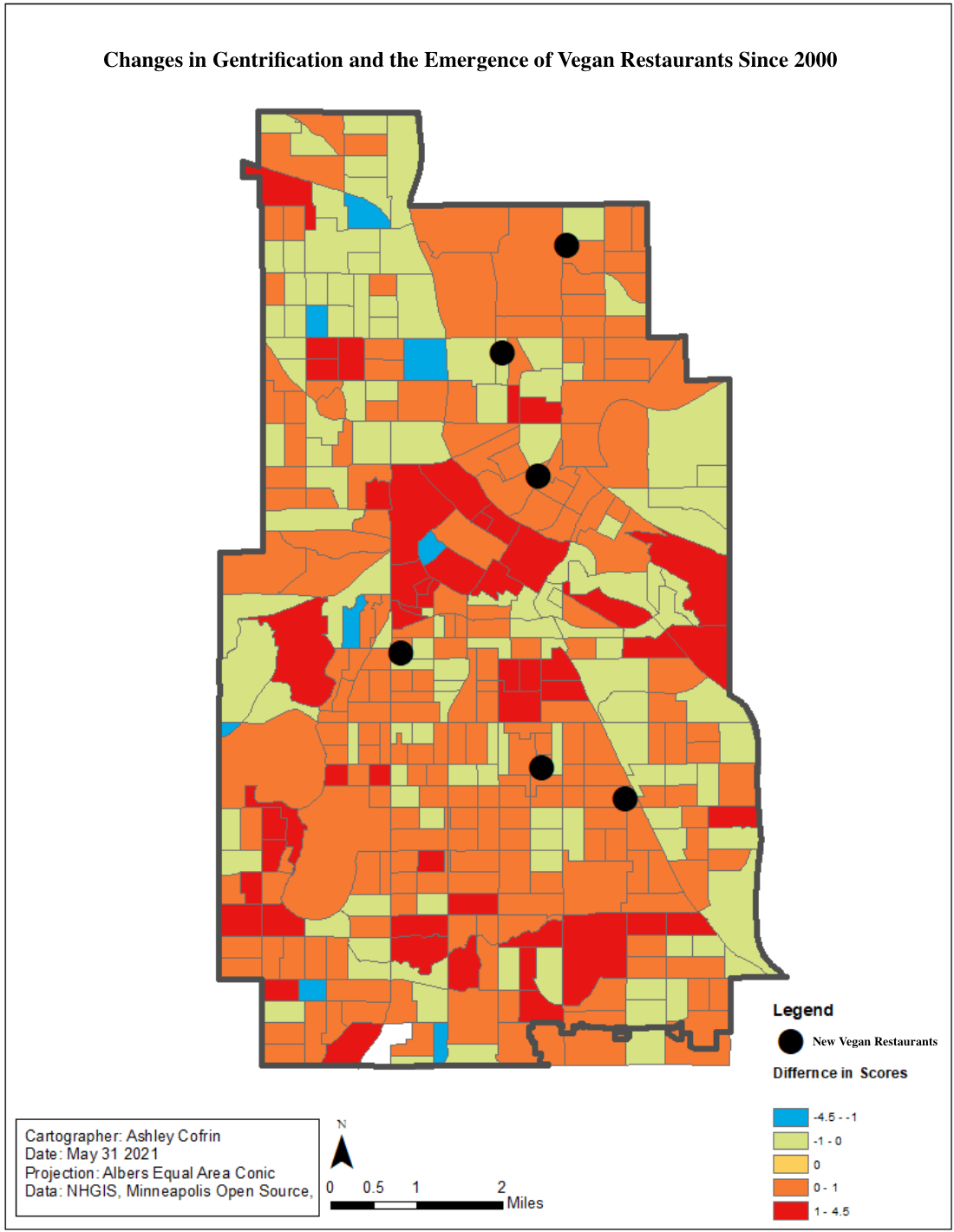
Figure 1: An anomaly graphic of Minneapolis “score of advantages” from 2018 to 2020. Warm colors indicate an increase in advantages over time, while cool colors indicate the opposite. This index score is referred to as “score of advantages” due to recent discussions considering that gentrification itself is hard to score and has many changing factors. The principal component analysis was calculated all years of data in Minneapolis using RStudio software. "New Restaurants" indicate restaurants that were present in 2018, and not 2000. This layer's point data was geocoded from 'Happy Cow', and year data was from each restraunts websities.
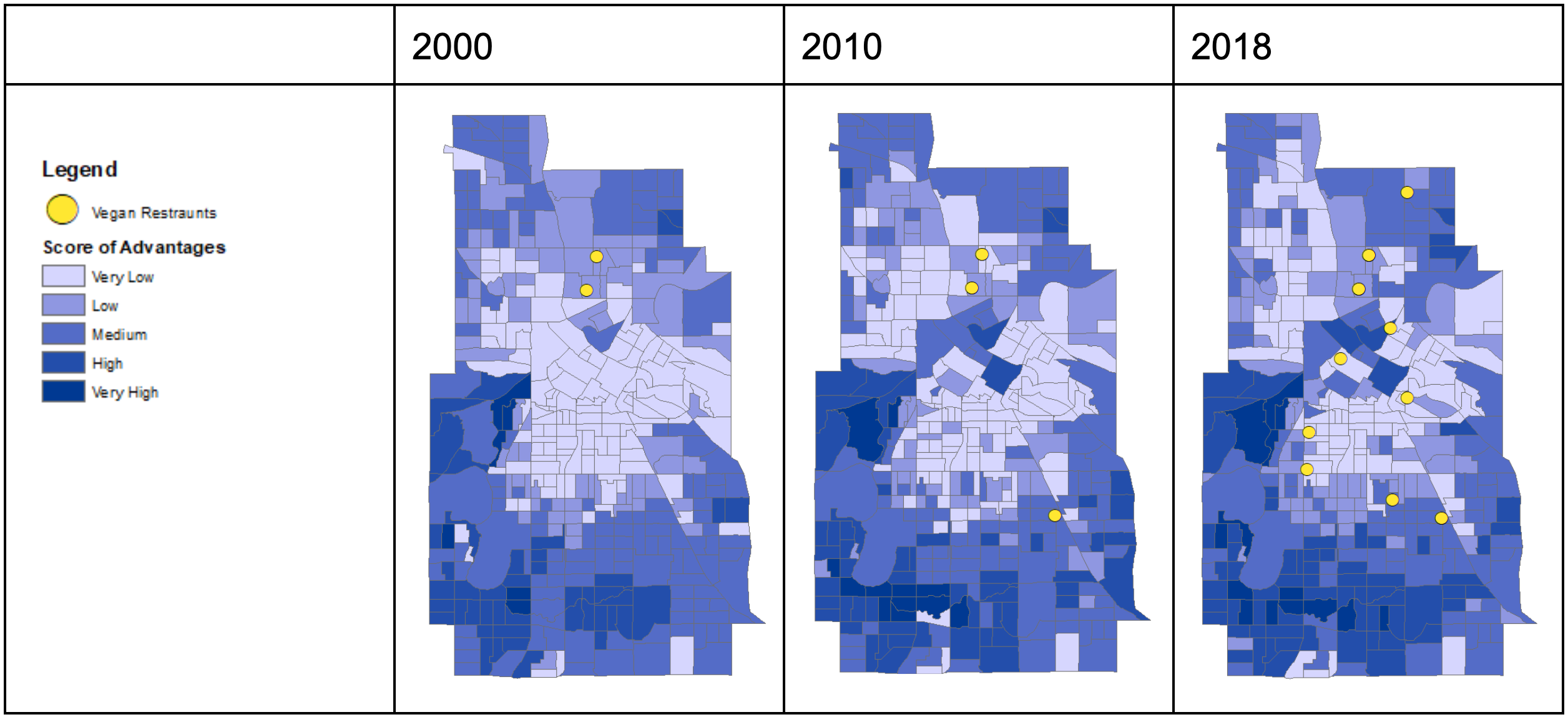
Figure 2: This figure displays the index scores in each year that there is census data from 2000 to the current day; along with points of what vegan restaurants are present that year, as georeferenced from “Happy Cow”. Classification of high and low are based on the natural breaks function.
Results
The results show that vegan restaurants that appeared between 2000 and 2018 are in areas that have more measured 'advantages' now than they did in 2000; while every time they are on the edge of an area that had slightly declined in their calculated advantages (Figure 1). None appeared in areas of ‘very’ increased advantages over the last 18 years. There is also a pattern of vegan restaurants surrounding the least advantaged area with nearly none in the middle; this least advantaged center slowly closes in over time (Figure 2). These patterns are indicative of vegan restaurants and gentrified areas moving spatially in similar ways although further research is required to understand the interaction between the two social phenomena. Veganism has many benefits on a personal and environmental scale; so while the trending diet may be spatially correlated to gentrification, it is not meant to be discouraged with these results. Future investigation should do community surveying to have a deeper understanding where a high density of people who eat vegan diets are, along with further research on defining gentrification.
References
Corsetti, Sophia. “The vegan movement is elitist.” The Massachusetts Daily Collegian, 2018, https://dailycollegian.com/2018/02/the-vegan-movement-is-elitist/.
Goetz, Edward G., et al. “The Diversity of Gentrification: Multiple Forms of Gentrification in Minneapolis and St. Paul.” (2019) http://gentrification.umn.edu/sites/gentrification.dl.umn.edu/files/media/diversity-of-gentrification-012519.pdf.
Happy Cow. https://www.happycow.net/.
Open Minneapolis. https://opendata.minneapolismn.gov/.
The National Historical Geographical Information System. https://www.nhgis.org/.